
In Gaza, women-headed households face ‘impossible choices’ to survive
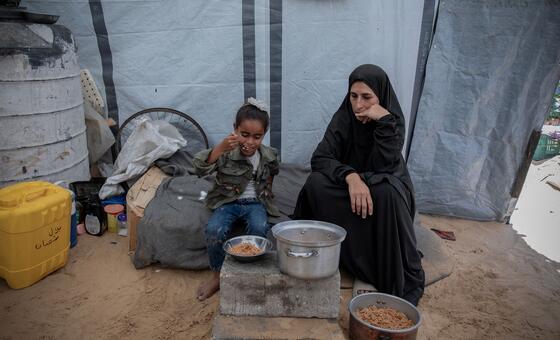
Survival Arithmetic: Gaza’s Women-Headed Households Forced Into Daily Calculations of Life and Death
Qinilo.com – In the rubble-strewn corridors of Gaza, a quiet but devastating demographic shift has taken hold. Nearly one in four households across the enclave is now led by a woman — an estimated 86,290 families — a figure that represents roughly double the share recorded before October 2023. For these women, the arithmetic of survival has become a daily, grinding exercise: how to stretch a handful of food across a week, whether to risk a journey for clean water, and how to keep children alive when shelter itself has been reduced to fragments of concrete and rebar.
UN humanitarians briefed journalists in Geneva on Tuesday, laying out what they described as an escalating crisis for women who now bear sole responsibility for household survival amid continuing Israeli airstrikes and resources that remain dangerously scarce.
A Ceasepaper That Has Not Stopped the Killing
The briefing arrived eleven months after a ceasefire agreement was struck between Hamas fighters and Israel. Yet the pause in large-scale hostilities has not translated into safety. Since October 2025, 246 Palestinian women and girls have been killed by Israeli air bombardment and military ground operations across Gaza.
“This is equivalent to six women and girls killed every week between October 2025 and 28 July 2026,” said Sofia Calltorp, Chief of Humanitarian Action at UN Women.
The broader casualty picture, as tallied by Gazan health authorities and relayed through the UN aid coordination office OCHA, stands at 1,303 fatalities and 4,336 injuries since the ceasefire took effect. Ongoing exchanges of fire have not ceased, and the humanitarian corridor remains fragile.
Names Behind the Numbers
Among those lost in the post-ceasefire period are individuals whose deaths underscore how indiscriminate the violence remains:
“[Raghad Ashour, 18, was] killed in an Israeli strike on her way to her 11th grade high school exam in Gaza City,” Ms. Calltorp told reporters. “Thirty-one-year-old Dina Almadhoun was killed in a strike in Gaza City; a six-year-old girl was killed in a helicopter strike on an encampment for displaced families in the Mawasi area of Khan Younis.”
Each of these deaths represents a household that may now be led by a widow, a grandmother, or a teenage sister — adding to the already overwhelming burden on women who must manage food, shelter, medical needs, and children’s schooling with virtually no institutional support.
Why Women-Headed Households Are Hit Hardest
UN Women’s analysis of household-level data reveals a stark disparity: women who head households are significantly more likely than their male counterparts to lack adequate shelter, sufficient food, and cash reserves. They are also more likely to have been displaced from their original homes or to have seen those homes destroyed outright.
The structural reasons are not obscure. In a context where formal employment has collapsed, where markets operate sporadically, and where movement is constrained by military checkpoints, women — who in many Palestinian households have historically managed domestic logistics rather than income generation — find themselves shouldering full economic responsibility with fewer tools, less mobility, and greater exposure to exploitation.
Confinement, Displacement, and the Shrinking Map
The war, ignited by Hamas-led terror attacks on Israel in October 2023, has displaced the majority of Gaza’s roughly 2.1 million residents. Palestinians are currently confined to less than 40 per cent of the Gaza Strip, as Israeli authorities continue to restrict civilian access to areas beyond what are designated the “Yellow” and “Orange” lines.
When the “Yellow Line” was first drawn following the ceasefire, it encompassed approximately 53 per cent of the territory. Subsequent expansions of restricted zones have pushed that figure down sharply, leaving around two-thirds of Gaza either entirely inaccessible to civilians or subject to severe access limitations. More than half the population — 58 per cent — now faces what OCHA classifies as critical or catastrophic shelter needs.
Access to food, drinking water, hygiene supplies, and essential services remains, in the words of the UN official, “severely limited.”
“There are restrictions on humanitarian access, insecurity and continued Israeli bombardment,” Ms. Calltorp explained. “Women heading households are every day forced to make impossible decisions on how to allocate scarce resources, how to access assistance and simply ensure the survival of those in their care.”
A Call for Full Implementation
UN Women closed its briefing with a direct appeal: the ceasefire must be implemented in full effect, humanitarian assistance must reach those in need at scale and without obstruction, and the design of every aid programme must be built around the specific needs of women and girls — including those who now head households alone.
“Responding to the realities faced by all women-headed households is essential to ensuring that women are seen, counted, empowered and supported,” the agency stated.
For the 86,290 women now managing households in a territory where two-thirds of the land is off-limits, where weekly casualty counts continue to climb, and where the next meal is a question answered by chance and courage rather than policy, that appeal is not abstract. It is the difference between a household that endures another week and one that simply does not.
Related Reading
Frequently Asked Questions
What is In Gaza women headed households face?
In Gaza women headed households face is the main topic of this guide. The article explains the context, practical details, and next steps readers should understand.
Why does In Gaza women headed households face matter?
In Gaza women headed households face matters because readers are looking for a useful answer, not just a short summary. Good content should match search intent and help them decide what to do next.