
Canada urges stronger partnerships as global order faces ‘rupture’
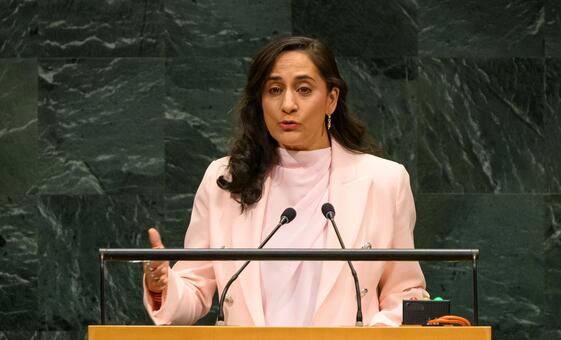
Canada Calls for Renewed Cooperation as Global Tensions Deepen
Qinilo.com – Canada’s Foreign Minister Anita Anand used her address to the United Nations General Assembly on Saturday to argue that international politics is undergoing a fundamental break rather than a gradual adjustment. In a period marked by conflict, economic fragmentation and pressure on international institutions, she said Canada intends to broaden its alliances while remaining firmly committed to multilateral action.
Her message placed sovereignty, international law and practical partnerships at the centre of Canada’s approach. Anand warned that powerful countries are moving away from economic integration and that respect for national sovereignty, a core principle of the UN Charter, is too often being undermined.
Opening with an image drawn from her roots in Nova Scotia, she compared the present moment to a changing tide that demands a response rather than hesitation.
“The tide does not wait. You must move with it.”
Anand said the shift confronting governments was not simply another stage in world affairs, but a sharper disruption with lasting consequences.
“The tide has turned in the global order,” she said, calling the moment a “rupture, not a transition”.
Strategic autonomy without isolation
Canada’s response, Anand explained, will include greater strategic autonomy. That means reducing excessive dependence on any single country or partner while expanding economic, diplomatic and security relationships across several regions.
The policy does not signal withdrawal from cooperation. Instead, it reflects an effort to give Canada more room to act when supply chains, trade ties or geopolitical partnerships become uncertain. Anand pointed to stronger engagement in the Indo-Pacific, the Gulf, Latin America, Africa and Europe, alongside renewed relationships with India and China.
She also described a plan to create flexible coalitions built around specific issues. These groups could bring together smaller countries, middle powers and major powers where their interests overlap. Canada sees support for Ukraine and Arctic security as two important areas for that kind of cooperation.
For Canada, such arrangements are meant to complement global institutions rather than bypass them. Anand stressed that partnerships should strengthen the multilateral system instead of replacing it with competing blocs or temporary alliances.
Support for reforming international institutions
Canada and like-minded partners have launched an initiative called Partners for Multilateralism, intended to support reforms at the United Nations and other international bodies. Anand said the goal is to make those institutions more representative, effective and trusted at a time when their credibility is being tested.
The case for reform is closely tied to her wider argument: global challenges do not stop at national borders, even when governments become more protective of their own interests. Wars, humanitarian emergencies, climate-related pressures, maritime insecurity and the rapid development of artificial intelligence all require sustained international coordination.
Anand called Canada’s broader approach “values-based realism.” Under that framework, the country plans to invest in its strategic capacity in emerging technologies, critical minerals, defence manufacturing and energy. The emphasis combines support for democratic principles and international law with preparation for a more competitive global environment.
Ukraine, the Arctic and regional security
On Ukraine, Anand reiterated Canada’s backing for a peace settlement that is comprehensive, just and durable. She said any lasting agreement must respect Ukraine’s sovereignty and territorial integrity, underscoring Ottawa’s continued position that borders cannot be redrawn through force.
The Arctic also featured prominently in her address. Anand described the region as essential to both Canada’s identity and national security. She highlighted cooperation with Indigenous peoples and with partners across the region, reflecting the Arctic’s importance in discussions of security, transportation, environmental change and northern communities.
Canada’s security concerns extend beyond its immediate region. Anand identified Iran as the principal threat to peace and security in its region, condemned attacks attributed to Tehran and said Iran must not obtain a nuclear weapon.
Two-State solution remains Canada’s position
Addressing the Israeli-Palestinian conflict, Anand said self-determination belongs to both Israelis and Palestinians. Her remarks framed those rights as inseparable rather than competing claims.
“Israel’s right to exist is not up for debate, and the right of the Palestinian people to self-determination in a state of their own is also not up for debate,” she said.
Canada remains committed to a negotiated two-State solution. Anand added that Hamas should have no governing role in Palestine and said Israeli settlements in the West Bank are illegal under international law.
She also cited Canadian support for security and electoral efforts in Haiti, humanitarian assistance for people affected by crises in Sudan and Gaza, and wider international cooperation on responsible artificial intelligence and maritime security.
A call for confidence in a changing world
Anand’s address presented Canada as a country seeking to adapt without abandoning the institutions and principles it considers essential. The strategy combines trade diversification, investment in strategic sectors, security partnerships and advocacy for a more credible international system.
Returning to her maritime theme, she rejected both nostalgia for an earlier global order and despair about the current one. Canada, she said, intends to act with confidence, uphold long-term partnerships and continue defending international law and the principles behind the United Nations.
“This is the path that Canada will take,” she concluded, “and we invite you to join us in partnership.”
Related Reading
Frequently Asked Questions
What is Canada urges stronger partnerships as global?
Canada urges stronger partnerships as global is the main topic of this guide. The article explains the context, practical details, and next steps readers should understand.
Why does Canada urges stronger partnerships as global matter?
Canada urges stronger partnerships as global matters because readers are looking for a useful answer, not just a short summary. Good content should match search intent and help them decide what to do next.