
Baristas behind bars: Thai prisoners brew a path back to daily life
Baristas behind bars: Thai prisoners brew a path back to daily life
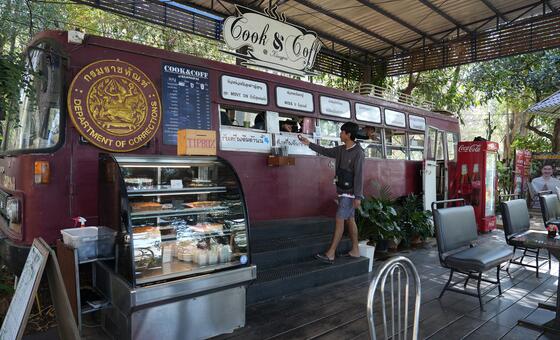
Qinilo.com – At first glance, it resembles a typical coffee shop, though its setting is unconventional—a repurposed red bus. A serving hatch is accessed via steps, and the menu displays various drink choices. Playful coffee-themed slogans, such as “My one and only love: Americano” and “Miss you a latte,” line the bus’s exterior.
Cook & Coff, situated in Khao Khuen Lan, eastern Thailand, operates under a unique model. Managed by the Department of Corrections and operated daily by incarcerated individuals, it serves as a community hub for reintegration efforts.
Tup’s Journey
Tup*, a 26-year-old inmate, is currently behind the counter. After serving six months in a maximum-security facility in Khlong Phai, northeastern Thailand, he was relocated to Khao Khuen Lan, a more open institution, where he developed his barista skills.
Each day, after his 3 p.m. shift ends, Tup returns to prison. This routine helps him reconnect with the outside world. Scheduled for release in 20 days, he eagerly anticipates reuniting with his mother. With her support, he plans to purchase a coffee machine and launch his own venture.
Rehabilitation Through Skills Training
Recidivism remains a significant hurdle. Manuchantrarut added, “Most prisoners revert to their original environments. Providing alternative employment opportunities allows them to alter their situations, reducing the likelihood of reoffending.” Skills training within correctional facilities provides a pathway for rehabilitation. The UN Office on Drugs and Crime (UNODC) collaborates with Thai authorities to ensure these initiatives have tangible outcomes, moving beyond theoretical policies to practical improvements in prison operations and living conditions.
In Tup’s former facility, where many inmates were from impoverished backgrounds, access to clean water was a financial burden. UNODC implemented a water purification system, transforming nearby lake water into safe drinking water.
Breaking the Cycle of Crime
These strategies stress that curbing recidivism involves tackling underlying issues—poverty, educational gaps, and social isolation—rather than relying solely on imprisonment. As Thitiphan Manuchantrarut, director of the Khao Prik Agricultural and Industrial Correctional Institution in Sikhio, northeastern Thailand, noted: “The real problem lies in society. Financial hardship drives individuals to drug trafficking. If they had access to the skills we teach here earlier in life, they might never