
AI, climate and conflicts top Guterres’s agenda ahead of General Assembly
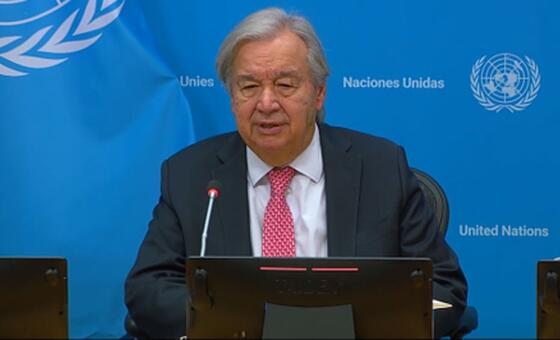
Guterres Urges United Action as General Assembly Week Nears
Qinilo.com – With world leaders due in New York in less than a week, UN Secretary-General António Guterres has warned that international cooperation is being tested by an increasingly unstable global landscape. He described the current period as “an era of deep uncertainty” and called on governments to respond collectively rather than retreat into division.
Speaking ahead of the UN General Assembly’s high-level week, the Secretary-General identified three threats with far-reaching consequences: the unchecked advance of artificial intelligence, the accelerating climate emergency and widening inequality. He also placed the wars affecting Gaza and Ukraine at the centre of the diplomatic agenda.
“Updating our structures can never mean abandoning our principles – it must mean applying those principles with even greater determination,” Mr. Guterres said.
His message combined a call for institutional reform with a defence of the UN’s founding commitments. While he accepted that global bodies, including the United Nations, must adapt to present-day realities, he stressed that peace, human rights, international law and sustainable development cannot become secondary priorities.
Conflicts expected to dominate discussions
The General Assembly is expected to consider the conflicts in the Middle East and Ukraine during the coming week. Mr. Guterres urged governments to focus on reducing tensions, using diplomacy and reopening meaningful dialogue where possible.
He described the devastation in Gaza as a major concern and renewed his support for a two-State solution. He said the suffering endured by Palestinians in Gaza demands urgent attention, while Israel’s annexation of the West Bank must end.
“At this crucial moment in the Middle East, de-escalation must be priority one, priority two and priority three,” the Secretary-General said.
He also called on every party involved in the Middle East conflict to safeguard civilians and respect navigation rights in the Strait of Hormuz and the Bab al-Mandab Strait. Both waterways are important international passages, and disruption there can deepen regional insecurity while affecting trade and the movement of essential goods.
On Ukraine, Mr. Guterres said that more than four years after Russia’s full-scale invasion, the prospect of an end to the war remains distant. He called for an immediate ceasefire as the opening step toward what he described as a just, durable and comprehensive peace.
For the UN, these crises illustrate the continuing gap between international commitments and conditions on the ground. The organization can provide humanitarian support, convene diplomacy and uphold legal principles, but lasting solutions still depend on political decisions by the parties involved and sustained engagement from Member States.
Artificial intelligence becomes a central global concern
Nearly half of Mr. Guterres’s remarks focused on artificial intelligence, reflecting the speed with which the technology has moved from a specialist issue to a central question for governments, businesses and the public. He recognized that AI could offer major benefits in areas including healthcare, education and climate action.
At the same time, he warned that innovation is advancing more quickly than the world’s understanding of the risks. Questions about safety, transparency, accountability and human control have become increasingly urgent as AI systems are deployed more widely.
Mr. Guterres said states have a responsibility to protect people from potential harms connected to AI and argued that national measures alone will not be enough. The challenge, he said, requires cooperation across borders.
“The world cannot afford a race to the bottom on AI safety,” he said.
His warning came amid concern about strategic competition between the United States and China over advanced AI. The Secretary-General acknowledged geopolitical divisions and cautioned that voluntary pauses in development would have little effect if only a small number of countries participated. An isolated approach, he suggested, cannot adequately manage a technology whose effects may cross national boundaries almost immediately.
He pointed to the UN-founded Independent International Scientific Panel on AI as an important resource for global policymaking. The panel is intended to bring the best available evidence into international discussions on both the opportunities created by AI and the dangers that may accompany it.
For policymakers, the central task is not simply to slow technology or encourage it without limits. It is to establish safeguards that allow useful innovation while reducing the possibility of abuse, discrimination, unsafe deployment or a loss of meaningful human oversight.
Mr. Guterres called for guardrails that “make AI safe, transparent and accountable, with human dignity at the centre.”
Climate and inequality remain part of the same challenge
Alongside war and artificial intelligence, the Secretary-General included the climate crisis and deepening inequality among the world’s most serious threats. These issues are closely connected to security and development: climate impacts can intensify pressure on communities, while unequal access to resources and opportunity can undermine social stability.
His appeal placed renewed emphasis on the UN Charter, international law and human rights as common standards for Member States. He urged countries to invest in sustainable development and to pursue peace in every region, arguing that shared problems require shared responsibilities.
As leaders prepare for the high-level week, the Secretary-General’s remarks set a demanding agenda. The immediate crises are severe, but the longer-term decisions on climate action, inequality and AI governance may shape the resilience of societies for years to come.
“International cooperation is more necessary than ever,” he said.
Related Reading
Frequently Asked Questions
What is AI climate and conflicts top Guterres?
AI climate and conflicts top Guterres is the main topic of this guide. The article explains the context, practical details, and next steps readers should understand.
Why does AI climate and conflicts top Guterres matter?
AI climate and conflicts top Guterres matters because readers are looking for a useful answer, not just a short summary. Good content should match search intent and help them decide what to do next.