
Guterres honours Indonesian troops who paid ‘ultimate sacrifice’
Guterres Pays Tribute to Indonesian Peacekeepers Killed in Lebanon
Qinilo.com – UN Secretary-General António Guterres has honoured four Indonesian peacekeepers who died while serving in Lebanon, describing their loss as a stark reminder of the dangers faced by personnel deployed to protect communities caught in conflict.
During a visit on Monday to the Indonesia Armed Forces Peacekeeping Centre in Sentul, Mr. Guterres laid a wreath for the fallen troops and offered condolences to their families. He said their deaths represented the highest price paid in the pursuit of peace and security.
“Their service and their sacrifice will never be forgotten. No one should die serving the cause of peace.”
The Secretary-General said attacks directed at UN peacekeepers cannot be treated as ordinary incidents of war. Such attacks, he stressed, are serious breaches of international humanitarian law and may constitute war crimes. He pledged to continue urging UN Member States to protect UN staff and peacekeeping personnel in every theatre of operation.
The ceremony came as Indonesian troops prepared for deployment to the Central African Republic, where the UN continues to support efforts to stabilize the country and strengthen state institutions. Mr. Guterres told the personnel that the UN’s uniformed peacekeepers remain an essential source of reassurance in places facing violence, political instability and humanitarian pressure.
“A source of hope in some of the world’s most troubled places.”
Indonesia’s role in global peacekeeping
Indonesia is among the world’s leading contributors to UN peace operations. Nearly 2,000 Indonesian uniformed personnel, including women and men, are serving in seven UN missions, making the country the sixth-largest contributor worldwide.
That contribution places Indonesia at the centre of the international system’s response to conflict. Peacekeepers are often sent far from their own communities and families, working in environments where armed groups, political tensions and weak public institutions can make daily operations dangerous. Their responsibilities can include reducing clashes between rival parties, helping humanitarian assistance reach civilians, supporting the protection of vulnerable populations and creating conditions in which political agreements can take hold.
Mr. Guterres said the UN has around 50,000 peacekeepers carrying out such work around the world. He described their service as a personal source of great pride, while underlining that their presence alone cannot solve a conflict. Durable peace requires political commitments, functioning institutions and sustained support for communities emerging from violence.
Indonesia will further underline its international peacekeeping role next year when it co-hosts the UN Peacekeeping Ministerial with the Netherlands. The gathering is expected to provide an opportunity for countries to consider how peace operations can respond effectively to changing security threats while maintaining the confidence of the people they are meant to protect.
Mission to the Central African Republic
Addressing troops destined for the Central African Republic, Mr. Guterres described the country as an unfinished success story. He has followed developments there for two decades, beginning during his time as UN High Commissioner for Refugees.
He said many armed groups have entered into agreements with the Government and have begun surrendering weapons. The deployment of Indonesian troops will be important in helping state institutions extend their work across the country’s full territory, he said.
The Secretary-General suggested that progress on this front could eventually allow the UN to reduce its mission in the Central African Republic in a gradual manner. Such a transition would depend on the ability of national institutions to provide security and services without the same level of international support.
In a lighter moment, Mr. Guterres told the departing personnel that he believed no “bad guys” in the Central African Republic would dare challenge Indonesians. The remark drew attention to the reputation Indonesian forces have developed through their repeated contributions to UN operations.
Call for a stronger multilateral system
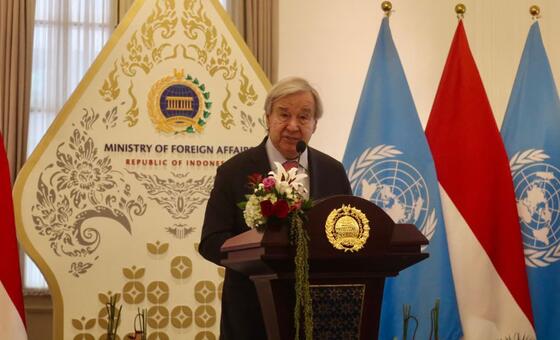
Later in Jakarta, Mr. Guterres used a meeting at the Ministry of Foreign Affairs to praise Indonesia’s broader diplomatic role. He called the country a pillar of multilateralism and highlighted its capacity to connect countries of the Global North and Global South.
His remarks came against a backdrop of expanding conflicts, widening inequality and falling public confidence in institutions. These pressures have led many people to question whether international cooperation can still produce practical results, particularly when global crises appear to outpace collective action.
“The answer to deepening frustration with multilateralism is not less multilateralism. It is better multilateralism.”
Mr. Guterres argued that international financial institutions and the UN Security Council should be reformed to better reflect the realities of the modern world. His appeal echoed a broader concern that global decision-making structures must become more representative if they are to retain legitimacy and respond effectively to shared challenges.
Gaza and Myanmar remain urgent concerns
Speaking alongside Foreign Minister Arrmanatha Nasir, the Secretary-General also addressed the continuing humanitarian and political emergencies in Gaza and Myanmar.
On Gaza, he said the suffering must end and called for the full implementation of the peace plan. He warned that the prospect of two States could vanish if action is delayed, while recognizing Indonesia’s longstanding support for the Palestinian people.
“The nightmare must end.”
Mr. Guterres also voiced alarm over the worsening crisis in Myanmar. He renewed his appeal for the protection of people escaping violence and persecution, including Rohingya refugees living across the region.
Across his visit, the UN chief’s message was consistent: peacekeeping, diplomacy and international cooperation remain difficult and imperfect, but abandoning them would leave civilians and conflict-affected societies with fewer protections. The tribute to the four Indonesian peacekeepers placed that message in deeply personal terms, honouring those who gave their lives while serving a mission intended to safeguard others.
Related Reading
Frequently Asked Questions
What is Guterres honours Indonesian troops who paid?
Guterres honours Indonesian troops who paid is the main topic of this guide. The article explains the context, practical details, and next steps readers should understand.
Why does Guterres honours Indonesian troops who paid matter?
Guterres honours Indonesian troops who paid matters because readers are looking for a useful answer, not just a short summary. Good content should match search intent and help them decide what to do next.