
Guterres: Old global order must change as power shifts to emerging economies
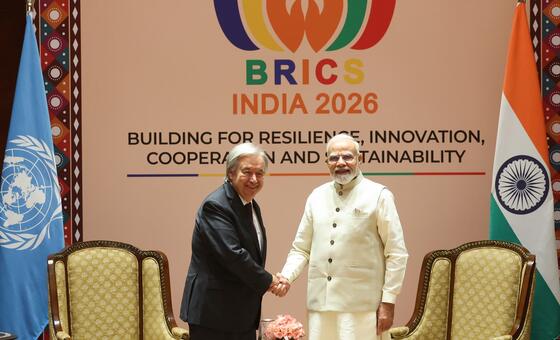
Guterres Urges Reform as Emerging Economies Gain Greater Global Influence
Qinilo.com – UN Secretary-General António Guterres called for major changes to the world’s post-war institutions on Sunday, telling leaders gathered in New Delhi that international decision-making must better reflect the economic, demographic and political realities of the present day.
Addressing a summit of leading emerging economies hosted by India, Mr. Guterres argued that the global framework created after the Second World War no longer corresponds to the distribution of power seen in 2026. He highlighted the need to modernize bodies ranging from the UN Security Council to the Bretton Woods institutions that shape international finance.
“Today’s economic, demographic and geopolitical realities are not those of 1945. Our institutional structures must reflect it.”
The summit brought together Brazil, Russia, India, China, South Africa and other countries that have joined the bloc. The group was established to amplify the role of large developing economies in a system historically dominated by Western states. This year’s meeting also included the heads of the World Health Organization and the World Trade Organization.
A world moving toward multiple centres of power
Guterres described the countries represented in New Delhi as evidence of a changing international landscape. Rather than seeing the rise of several influential centres of power as a threat, he said it could help produce a fairer global system if accompanied by meaningful institutional reform.
“Countries represented at this Summit speak to that changing reality.”
He said the world is increasingly becoming multipolar, with influence spread more broadly across regions and economies. In his view, that evolution could improve balance and equity in global governance, but only if international institutions are redesigned to match it.
The Security Council remains one of the clearest examples of this debate. Its permanent membership reflects the outcome of the Second World War, while many countries with substantial populations, regional influence and economic weight have long sought a stronger role in decisions affecting international peace and security.
Guterres also included the Bretton Woods system in his call for reform. Institutions created in the mid-1940s remain central to global development lending and financial stability. His message was that they must become more responsive to the needs and representation of developing countries facing major investment gaps.
Finance and development needs
One of four priorities identified by the Secretary-General was financing for inclusive global growth. He said developing countries require far greater international backing if they are to achieve the Sustainable Development Goals, the UN’s broad agenda covering poverty, health, education, equality, climate action and other development priorities.
Multilateral development banks, he said, should become “bigger, better and bolder.” The appeal reflects a wider push for institutions that can provide more affordable financing and mobilize investment on a larger scale for countries managing infrastructure demands, climate risks and social development needs simultaneously.
For many emerging and developing economies, access to financing can determine whether global commitments translate into practical projects. Funding for energy systems, transport, health services, schools and climate resilience often depends on borrowing conditions and international support that are beyond the control of national governments alone.
Technology, climate justice and peace
Guterres also warned that artificial intelligence could deepen inequalities if its development and benefits remain concentrated among a limited number of countries and corporations.
“Its power sits with a few companies, in a few countries. Unchecked, the AI divide will widen every other divide — in income, in opportunity, in security, and in sovereignty.”
His remarks connected technological access with national independence and economic opportunity. Countries without the computing capacity, data resources, skills or investment needed to use advanced AI risk falling further behind as the technology becomes more important to public services, business and security.
Climate change was another central theme. Guterres pointed to extreme heat, glacier loss, wildfires and flooding as warnings of intensifying disruption. He said a stronger El Niño event would worsen existing pressures as the world nears the 1.5-degree Celsius warming threshold above pre-industrial levels.
“Scorching heat, devastating glacier melt, raging wildfires, devastating floods are all a preview.”
He urged wealthier countries to fulfil commitments that include $300 billion annually, a threefold increase in adaptation finance and expanded support for loss and damage. He also criticized the treatment of critical minerals, resources increasingly important for energy technologies and industrial production.
“Enough plundering.”
The Secretary-General’s final priority was peace and security. He referred to Gaza, the broader Middle East, Ukraine and Sudan, emphasizing that states must respect the UN Charter. He specifically cited sovereign equality, territorial integrity and the peaceful settlement of disputes as principles that should guide international conduct.
Guterres concluded that reform should not be seen as a benefit granted by one group of countries to another. Instead, he presented it as a collective responsibility in a world where cooperation is necessary to address conflicts, climate threats, development gaps and technological change.
“As we move irreversibly to a multipolar world, all countries must work to strengthen and safeguard a multilateral system that delivers for all with the United Nations at its centre.”
Related Reading
Frequently Asked Questions
What is Guterres?
Guterres is the main topic of this guide. The article explains the context, practical details, and next steps readers should understand.
Why does Guterres matter?
Guterres matters because readers are looking for a useful answer, not just a short summary. Good content should match search intent and help them decide what to do next.