
UN General Assembly elects Bangladesh’s Rahman as next president
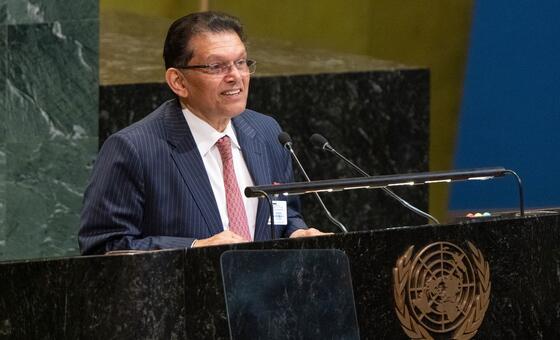
UN General Assembly Appoints Bangladesh’s Rahman as New President
Qinilo.com – The United Nations General Assembly has elected Khalilur Rahman, Bangladesh’s Foreign Minister, as the next president of the 81st session, marking a significant milestone in global leadership. This decision was reached after a closely contested election, with Rahman emerging victorious over Andreas Kakouris of Cyprus. His leadership will now guide the UN through a year defined by pressing global issues, including climate change, geopolitical tensions, and the ongoing search for a successor to António Guterres. The UN General Assembly elects Bangladesh’s Rahman as a unifying figure in a world where multilateral cooperation is increasingly vital.
The election took place during a secret ballot, with Rahman securing 99 votes against Kakouris’s 91. A total of 190 ballots were cast, and all were valid, with no abstentions recorded. Rahman’s term will begin on 9 September 2026, positioning him at the helm of the Asia-Pacific regional group, which rotates the presidency among UN member states. This arrangement ensures that diverse perspectives are represented, with Rahman’s election as president of the General Assembly reflecting Bangladesh’s growing influence in international affairs.
A Strategic Transition for the UN
The UN General Assembly elects Bangladesh’s Rahman to lead a critical period in the organization’s history. His presidency will coincide with the selection of Guterres’s successor, a process expected to finalize by December 2026. This timing underscores the need for a leader capable of steering the UN through a landscape of challenges, from stalled progress on Sustainable Development Goals (SDGs) to funding shortages for humanitarian efforts. Rahman’s background in diplomacy and his focus on reform have positioned him as a candidate with both experience and vision.
Rahman’s selection also comes amid heightened scrutiny of the UN’s effectiveness. Current President Annalena Baerbock of Germany highlighted the organization’s struggle to maintain consensus in an era of rising divisions. She emphasized that the UN General Assembly elects Bangladesh’s Rahman’s leadership could help reinvigorate the institution’s credibility. “We are facing not only headwinds but immense pressure to adapt to today’s realities,” Baerbock stated, underscoring the importance of unified action in addressing global crises.
Secretary-General António Guterres praised Rahman’s election, calling it a step toward strengthening the UN’s role in fostering international cooperation. He noted that the current era is marked by conflicts, inequality, and climate change, all of which require coordinated global responses. Guterres expressed confidence that the UN General Assembly elects Bangladesh’s Rahman would prioritize reforms to enhance the organization’s relevance and efficiency. “The UN must be a beacon of hope in a time of uncertainty,” he said, highlighting the significance of this transition for the future of multilateralism.
Rahman’s Leadership Agenda
Rahman, a seasoned diplomat with over 40 years of service, has outlined six key priorities for his presidency: peace and security, advancing SDG implementation, climate action, human rights, emerging technology governance, and UN reform. His experience as National Security Adviser and High Representative on the Rohingya Issue has equipped him to tackle complex international challenges. Since joining the Bangladesh foreign service in 1979, Rahman has held pivotal roles in New York and Geneva, building a reputation for diplomacy rooted in inclusivity and resilience.
“The UN General Assembly elects Bangladesh’s Rahman to lead at a time when trust in our organization is being tested on multiple fronts,” he stated in a speech. “These challenges threaten to undermine public confidence in the UN’s ability to deliver on its promises.”
“We must restore the UN’s credibility and ensure it remains a platform for all nations to find common ground,” he added, stressing the importance of collaboration in addressing global inequities and fostering unity.
Rahman’s campaign focused on bridging gaps between developed and developing nations, ensuring the UN General Assembly elects Bangladesh’s Rahman can champion the needs of smaller delegations. He has also emphasized the need for institutional modernization, particularly in adapting to the digital age and strengthening the Global Digital Compact. His vision aligns with the UN’s goal of being a more effective and equitable body, capable of responding to the challenges of the 21st century with renewed vigor.
The election of the UN General Assembly elects Bangladesh’s Rahman is seen as a symbol of the Asia-Pacific region’s growing voice in global