
‘The ocean has no boundaries’: Beauty and life in a war zone
‘The ocean has no boundaries’: Beauty and life in a war zone
Qinilo.com – World Oceans Day, observed annually on June 8, this year emphasizes the need to reimagine the bond between humans and the sea. For three divers based in the United Arab Emirates, this theme took on a deeply personal meaning as they returned to the waters of the Strait of Hormuz after months of restriction. The narrow channel, just 34 kilometers wide at its narrowest point, had become a global symbol of tension following a major geopolitical event in early 2026.
On February 28th, US and Israeli forces targeted Iran, sparking a major geopolitical crisis. The Strait of Hormuz, a critical artery for global trade, was swiftly closed to foreign vessels. This closure disrupted approximately 20% of the world’s seaborne oil shipments and left around 20,000 seafarers stranded in the Persian Gulf. The UN Secretary-General urged an immediate halt to hostilities, highlighting the urgent need for calm in the region.
A Return to the Depths
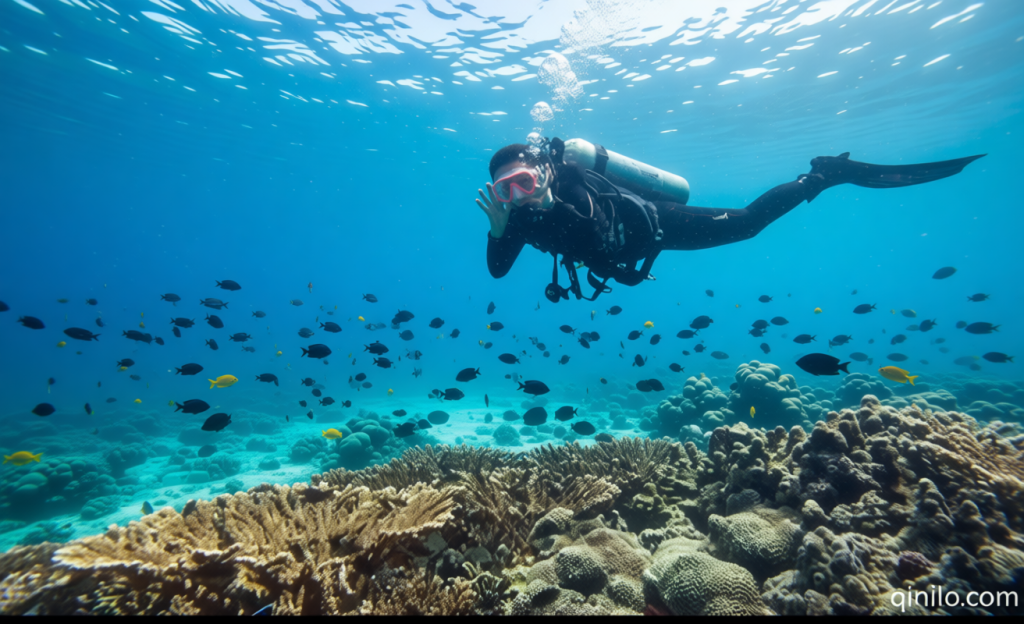
Three Chinese divers—Rui Li, Shanshan Du, and Jie Zhang—had been unable to explore the strait’s waters for weeks due to the coastal blockage. When the ceasefire permitted limited access in mid-April, they quickly resumed their dives, uncovering a world that had persisted beneath the surface of the conflict.
“We were actually a little worried before setting off,” says Du, who dived the narrowest stretch between the UAE and Oman on April 18. “But after more than two months, we all felt it was fantastic to be able to dive again. We encountered a large group of dolphins. There was none of the war-torn atmosphere I had imagined—only peace and beauty before my eyes.”
Du’s words reflect a shared experience among the three. Zhang, who dived the area just days before, describes an unexpected abundance of marine life. “The coral diversity here is rare,” she notes. “Soft and hard corals vary with the topography, and sea turtles gather in such numbers they feel like a nature reserve.”
Submerged Signs of Strain
Yet the underwater realm was not untouched by the turmoil above. Zhang observed a troubling sight: “I saw more white debris on the seabed than before,” she says, uncertain of its source. During a dive near the eastern side of the strait, she noted that the water around dolphins was streaked with green algae, oil fumes, and floating trash.
“I recalled that when I used to chase dolphins, the water was blue. Seeing this scene with my own eyes is still very heartbreaking,” Zhang adds.
Li, meanwhile, highlights the strait’s unique ecological features. “It’s not the world’s most biodiverse marine zone,” he explains, “but its complex topography supports coral reefs of unusual variety—formations ‘as white as silver needles’ alongside colonies ‘as purple as pine forests’—alongside seahorses, whale sharks, and species rarely seen elsewhere.”
A Shared Metaphor for the Sea
Li offers a metaphor that captures the fragile dynamic between humanity and the ocean. “The relationship between people and the sea is like that between a child and a parent,” he says. “The ocean sustains us, nurtures us, and occasionally punishes us. We’ve grown old enough to want to protect it, yet what we can actually do remains small. Our parents are still quietly waiting for us, helping us, and continuing to nurture us.”
Du, who dives in a region where people from dozens of nationalities intersect, finds the ocean’s unity striking. “Underwater, borders feel beside the point,” she observes. “Communication happens through gesture alone.”
Voices from the Deep
Zhang frames the ocean’s vulnerability with blunt clarity. “No one can speak for the underwater ecosystem—fish can’t speak, and neither can large animals,” she says. “We dump all the disputes, wars, and pollution on land onto the ocean, ignoring the fact that the ocean has no good self-protection capabilities and can only bear all the conflicts and damage caused by human activities.”
Despite the challenges, the divers’ journeys reveal a quiet resilience. Their dives, conducted in the shadow of conflict, offer a glimpse of the sea’s enduring beauty—and a reminder of the stakes involved in preserving it.